


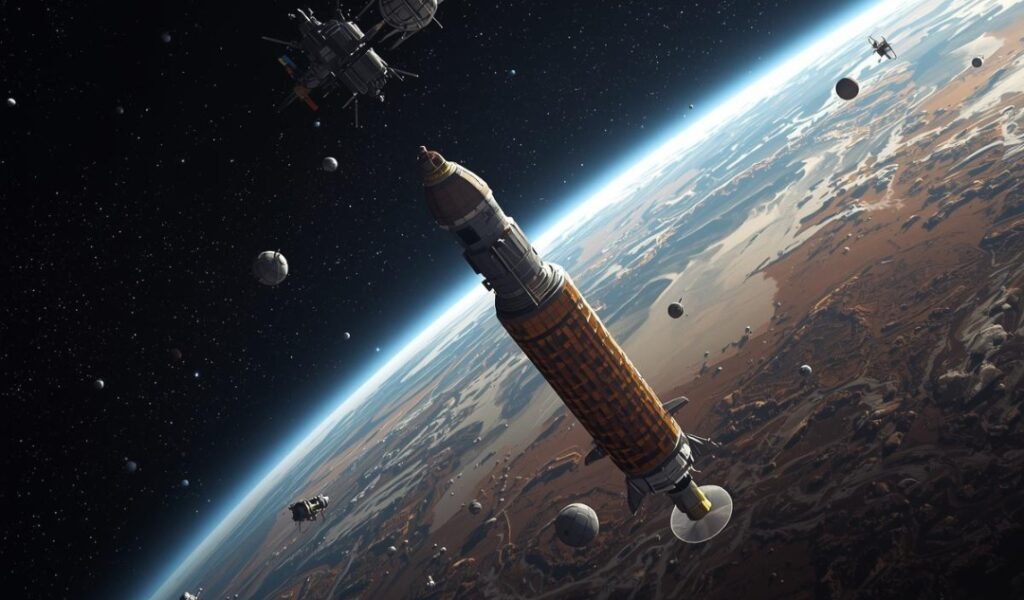
The journey of space exploration is one of humanity’s greatest achievements. From the first attempts to leave Earth’s atmosphere to today’s advanced missions exploring distant planets and beyond, space missions have evolved dramatically over the decades. This evolution reflects not only technological progress but also humanity’s growing curiosity about the universe.
The story begins in the mid-20th century during the space race between the United States and the Soviet Union. In 1957, the Soviet Union launched Sputnik 1, the first artificial satellite to orbit the Earth. This historic event marked the beginning of space exploration. Soon after, space missions focused on sending humans into space. In 1961, Yuri Gagarin became the first human to orbit Earth, proving that space travel was possible for humans. This era reached its peak in 1969 when NASA’s Apollo 11 mission successfully landed the first humans on the Moon, a milestone that remains one of the most iconic moments in history.
Following the success of early missions, the focus shifted toward long-term space exploration and scientific research. Space agencies began launching probes and satellites to study planets, stars, and cosmic phenomena. Missions like Voyager 1 and Voyager 2, launched in 1977, explored the outer planets and continue to send data from beyond our solar system. At the same time, space stations such as Skylab and later the International Space Station (ISS) allowed astronauts to live and work in space for extended periods, conducting experiments that are impossible on Earth.
As technology advanced, space missions became more sophisticated and diverse. Robotic missions started playing a major role, reducing risks to human life. Mars exploration became a major focus, with rovers like Spirit, Opportunity, Curiosity, and Perseverance sending valuable data about the Red Planet’s surface and environment. These missions have helped scientists understand the possibility of life beyond Earth and prepare for future human missions to Mars.
In recent years, the evolution of space missions has taken an exciting turn with the involvement of private companies. Organizations like SpaceX, Blue Origin, and others are developing reusable rockets, significantly reducing the cost of space travel. This has opened new possibilities for commercial spaceflight, satellite deployment, and even space tourism. The idea of humans becoming a multi-planetary species is now being seriously considered.
Another important development is the focus on deep space exploration. Missions such as the James Webb Space Telescope are providing unprecedented views of distant galaxies, helping scientists study the origins of the universe. Future missions aim to explore asteroids, return samples from Mars, and even send humans beyond the Moon once again through programs like NASA’s Artemis mission.
Despite these advancements, space missions still face many challenges, including high costs, technical risks, and the harsh conditions of space. However, continuous innovation and international collaboration are helping overcome these obstacles.
In conclusion, the evolution of space missions shows how far humanity has come in exploring the unknown. From the first satellite to advanced interplanetary missions, each step has expanded our understanding of the universe. As technology continues to improve, the future of space exploration looks even more promising, with possibilities that were once considered science fiction becoming reality.