


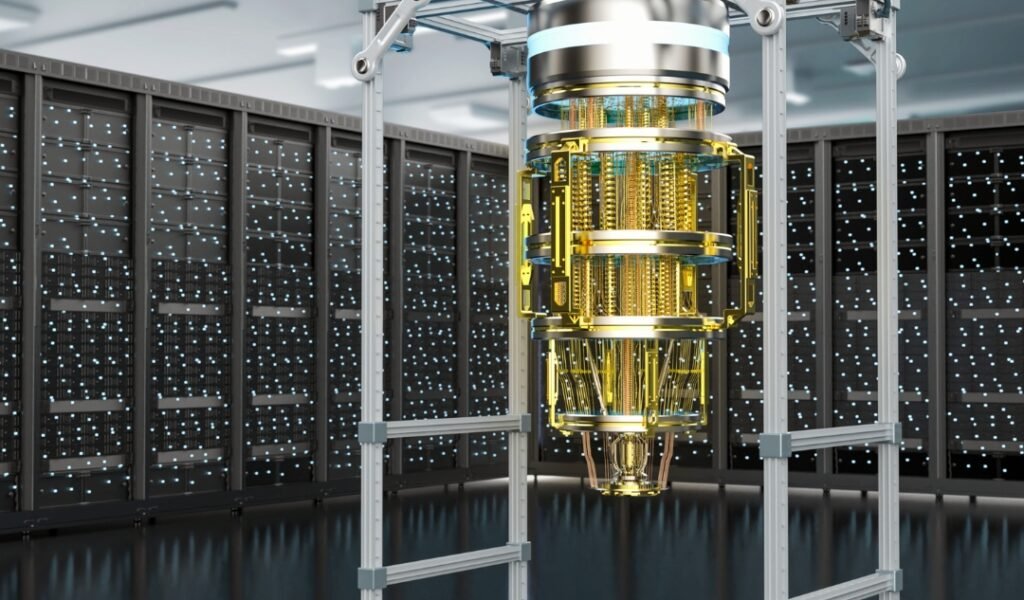
In a remarkable advancement in the field of quantum computing, China has introduced Zuchongzhi 3.0, a 105-qubit superconducting quantum processor that is being described as a major breakthrough in modern technology. This powerful system has successfully performed a highly complex calculation in just a few seconds—something that would take the world’s fastest classical supercomputer an estimated 5.9 billion years to complete. Such an achievement highlights a new level of computational capability and brings us closer to the era of quantum advantage.
To understand the significance of this breakthrough, it is important to look at how quantum computers differ from traditional ones. Classical computers rely on bits that represent either 0 or 1. In contrast, quantum computers use qubits, which can exist in multiple states at the same time due to a property known as superposition. Additionally, qubits can be entangled, allowing them to process vast amounts of information simultaneously. This unique behavior enables quantum computers to tackle problems that are practically impossible for classical systems.
Zuchongzhi 3.0 represents a major step forward compared to earlier quantum processors. With 105 qubits, it offers increased computational power and improved performance. The recent experiment involved solving a specialized and extremely complex sampling problem used to test the limits of computing systems. While this type of problem may not yet have direct real-world applications, it serves as a critical benchmark, proving how far quantum computing has progressed.
The potential impact of this breakthrough is enormous. Quantum computers have the ability to transform industries such as cryptography, artificial intelligence, drug discovery, and materials science. They could help scientists simulate molecular structures for new medicines, optimize large-scale systems, and solve mathematical problems that are currently beyond reach. This level of power could redefine how we approach some of the world’s most complex challenges.
Despite this major breakthrough, there are still challenges ahead. Quantum systems are highly sensitive and require extremely low temperatures to function properly. Issues such as error rates, qubit stability, and scalability continue to be key obstacles. However, rapid advancements in research and engineering suggest that these challenges may be overcome in the near future.
This development also highlights the growing global competition in advanced technologies. Nations around the world are investing heavily in quantum computing, recognizing its potential to shape the future of science, industry, and national security.
In conclusion, Zuchongzhi 3.0 stands as a major breakthrough that showcases the incredible potential of quantum computing. While practical applications are still developing, this achievement proves that we are entering a new era of computation. As progress continues, quantum technology is set to unlock possibilities that were once considered unimaginable, pushing the boundaries of innovation and transforming the future of computing.