


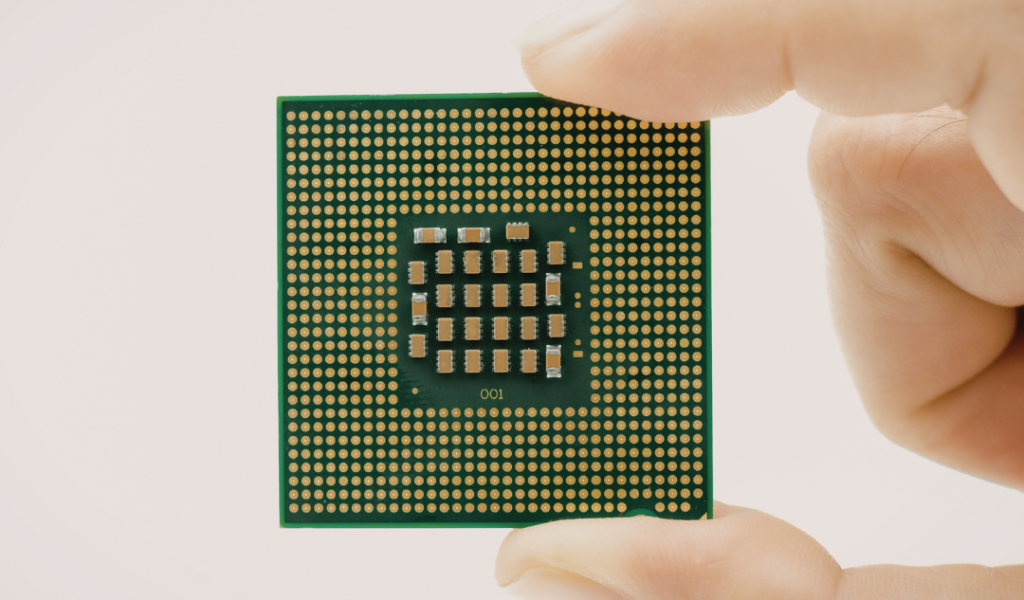
Microchips, or integrated circuits (ICs), form the foundational infrastructure of contemporary digital systems. From embedded controllers in household appliances to high-performance processors in data centers, microchips enable computation, communication, and automation at unprecedented scales. This article presents a structured and educational overview of microchip technology, focusing on their architecture, functionality, manufacturing, and evolving significance.
1. Definition and Fundamental Structure
A microchip is a miniaturized electronic circuit fabricated on a semiconductor substrate, most commonly silicon. It integrates a large number of electronic components—primarily transistors—along with resistive and capacitive elements into a single compact unit.
The invention of integrated circuits marked a critical advancement in electronics by replacing discrete components with scalable, efficient, and reliable systems.
2. Core Operating Principles
Microchips operate based on the manipulation of electrical signals through semiconductor devices. The primary building block, the transistor, functions as a switch that controls current flow.
Digital microchips utilize binary logic:
- Logic “1” represents a high voltage level
- Logic “0” represents a low voltage level
Through combinations of logic gates (AND, OR, NOT, etc.), microchips execute arithmetic operations, decision-making processes, and data transformations. These operations are governed by clock signals that synchronize processing tasks within the system.
3. Classification of Microchips
Microchips can be categorized based on their functional roles:
- Microprocessors (CPUs): General-purpose processing units responsible for executing instructions and managing system operations
- Microcontrollers (MCUs): Integrated systems combining a processor, memory, and input/output peripherals, widely used in embedded applications
- Memory Devices:
- Volatile memory (RAM) for temporary data storage
- Non-volatile memory (ROM, Flash) for permanent storage
- Application-Specific Integrated Circuits (ASICs): Custom-designed chips optimized for dedicated functions such as signal processing or cryptographic operations
4. Semiconductor Fabrication Process
The manufacturing of microchips involves highly controlled processes conducted in cleanroom environments:
- Silicon Wafer Production: High-purity silicon is grown into crystals and sliced into wafers
- Photolithography: Ultraviolet light is used to transfer circuit patterns onto the wafer surface
- Etching and Ion Implantation: Material is selectively removed or modified to create circuit elements
- Layer Deposition: Multiple layers of conductive and insulating materials are added
- Packaging and Testing: Completed chips are enclosed and rigorously tested for functionality and reliability
Advancements in fabrication technology are often measured in nanometers (e.g., 5 nm, 3 nm), indicating the scale of transistor features.
5. Importance in Modern Technology
Microchips are indispensable across multiple domains:
- Computing Systems: Enable data processing in personal and enterprise environments
- Telecommunications: Support high-speed data transmission and networking
- Automotive Industry: Power control systems, safety features, and autonomous technologies
- Healthcare: Facilitate diagnostic devices, medical imaging, and wearable technologies
Their integration has significantly enhanced efficiency, precision, and scalability in technological systems.
6. Emerging Trends and Future Directions
The evolution of microchips continues to address challenges related to performance, power consumption, and physical limitations. Key trends include:
- Miniaturization and Moore’s Law: Continued scaling of transistor density, though approaching physical limits
- Artificial Intelligence Accelerators: Specialized chips designed for machine learning workloads
- 3D Integration: Vertical stacking of chip layers to improve performance and reduce footprint
- Quantum Computing Research: Exploration of fundamentally new computational paradigms
Conclusion
Microchips represent one of the most significant engineering achievements of the modern era. Their ability to integrate complex circuitry into microscopic dimensions has transformed industries and redefined technological capabilities. A comprehensive understanding of microchip architecture and operation is essential for students, engineers, and researchers seeking to contribute to the future of electronics and computing systems.